
Excavation Within Root Zones: Lessons from Cannons Creek Library
A NEW SPACE FOR A GROWING COMMUNITY
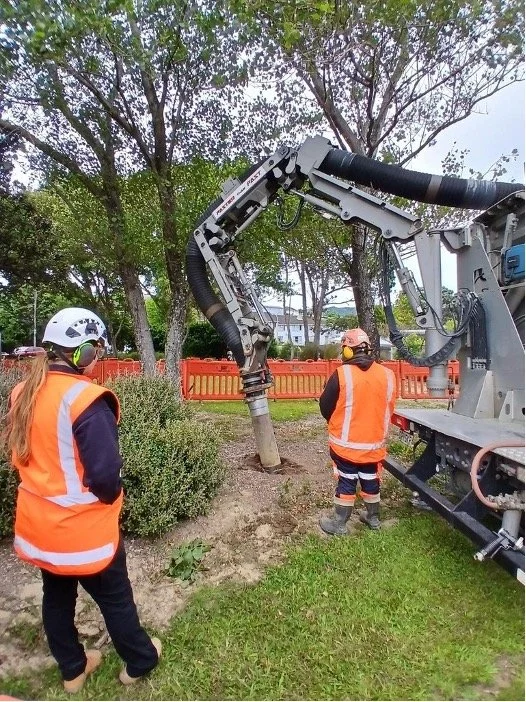
This January, Tend Tree Consultancy was on site for the initial stages of the construction of Porirua’s newest community hub.
The existing Cannons Creek Library has outgrown its premises within a row of shops and will relocate to nearby Bedford Reserve. The new building will be twice the size of the original library, incorporating modern, modular facilities that allow for future expansion as community needs grow. The location will be close to the local pool and playground, and well connected to beautiful outdoor spaces in nearby Cannons Creek Park, where Tend Tree Consultancy has also been assisting with upgrades currently underway. The new library will feature an internet hub, requiring installation of underground power and fibre infrastructure.
Bedford Reserve currently hosts seven mature trees that provide shade, personality and ecological value to the area, as well as offering a potential space to sit and enjoy a good book. To ensure success for both construction and the health of Bedford Reserve’s trees, our teammate Alice oversaw the installation of below-ground electrical and internet services for the new building.
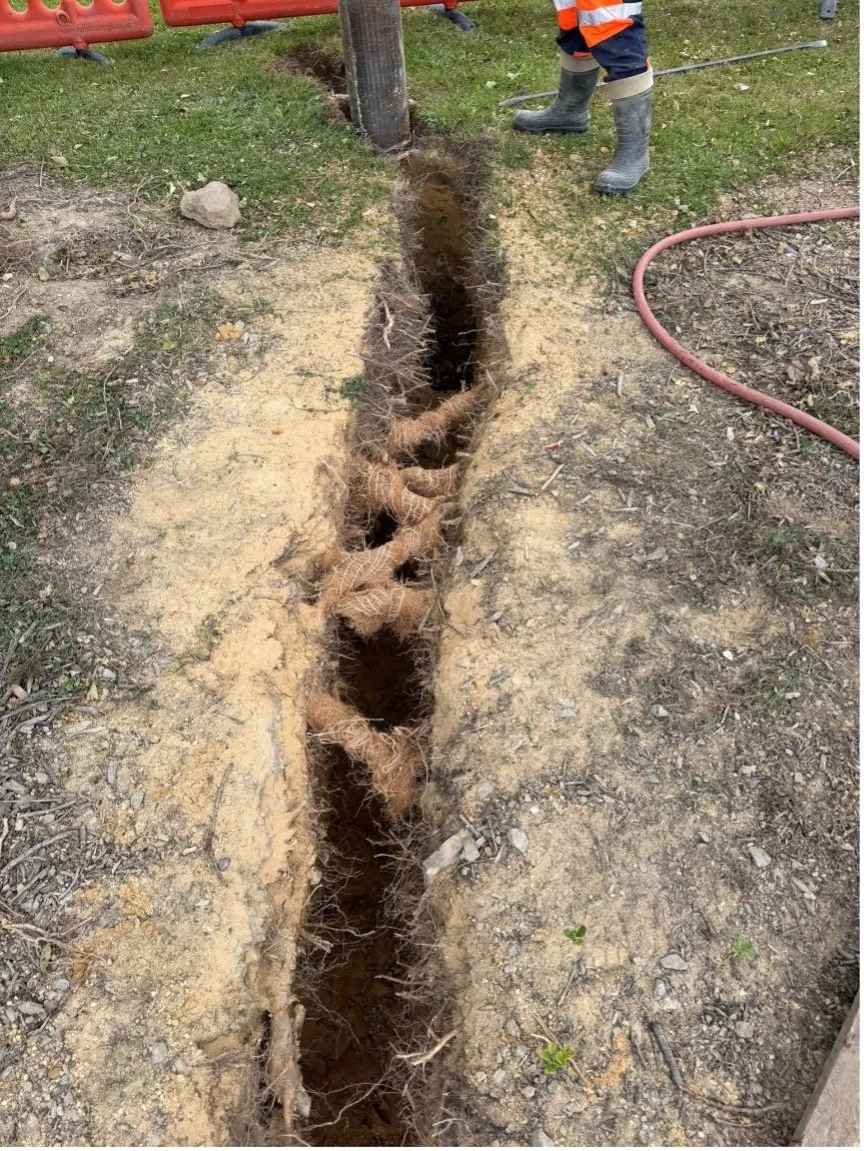
We used AirVac excavation to create trenches that were within the structural root zones and/or the tree protection zone of the nearby trees. Exposing the roots as the topsoil and clays were removed allowed Alice to determine whether the roots would be pruned or preserved. Remaining roots had the soil carefully vacuumed around and lastly wrapped in hessian to ensure they would not dry out before backfilling.
Every decision we made on this project took into account the structure, role, and long-term health of trees’ underground systems.
Tree Roots
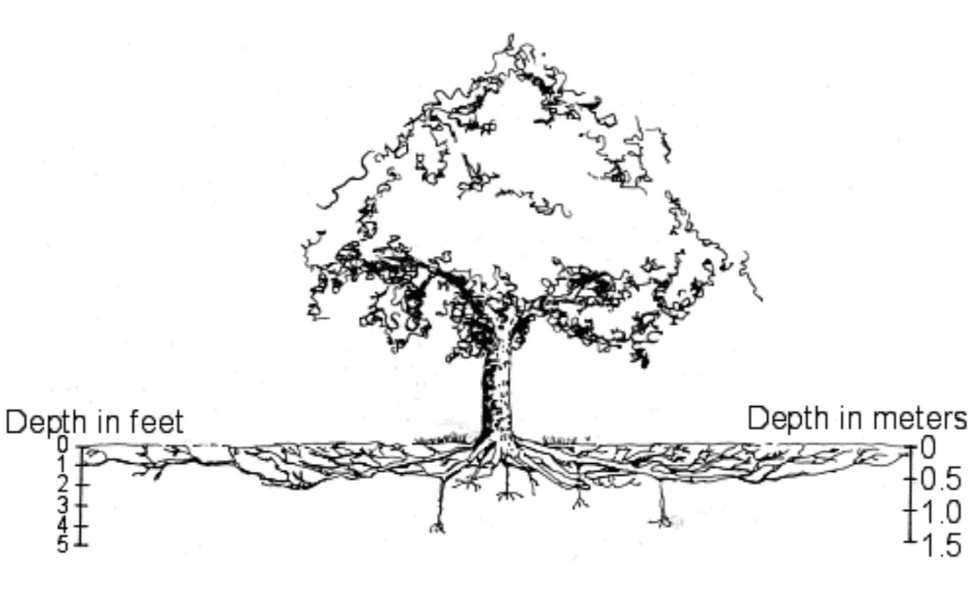
Image Source: (Watering Mature Shade Trees | CSU Extension, 2025)
Although we don’t often think about the below-ground parts of a tree, roots can comprise around one third of a tree’s total biomass and are often the portion most impacted by construction activities. Root systems are easily damaged, and the consequences of this damage are not always immediate. Poor excavation practices can compromise trees’ stability and vitality, as well as create future safety and maintenance obligations.
The whole picture
When people picture tree roots, they often imagine a mirror image of a tree’s canopy, but underground, the reality is quite different. Although some trees may have one or two deeper “tap roots”, most tree roots grow outwards from the tree within the top 1m of soil. This growth can extend outwards to an area of up to three times the canopy width in ideal conditions.
A useful metaphor for imagining the tree’s structure is that of a wine glass on a dinner plate, with the wine glass representing the tree’s buttress, trunk, and canopy, and the plate representing its root dimensions. The Tree Protection Zone (TPZ) is the portion of this system that is most needed for its long-term continued health and growth. When construction occurs within the TPZ, we disrupt the important roles that roots play in a tree’s survival. But what are those roles?
What do a tree’s roots do?
To understand how construction impacts trees, one must first understand the three major roles that tree roots play.
Anchorage and stability - The tree’s larger roots provide a foundation, anchoring it in place and keeping it upright through all weather conditions – which is no easy feat in the windy Wellington region! Physical damage to these roots can significantly reduce the tree’s structural stability.
Absorption and transportation of water and mineral nutrients – Most of us know that trees generate food as sugars through photosynthesis, but that process requires water and nutrients from the soil. Tree roots draw in and transport these substances throughout the tree, providing the fuel for all of its life processes. Soil compaction or alteration of soils can limit these abilities, but it may take multiple growing seasons for the damage to fully manifest.
Storage of food reserves – Trees store carbohydrates as starches to fuel growth and recovery when conditions are not ideal. This is particularly critical for deciduous species that drop their leaves each autumn and rely on stored energy to produce new foliage in spring, but all trees use these reserves to recover from stress such as drought or defoliation. Reducing the root area of a tree can reduce its capacity to “bounce back” from poor growing seasons.
Reducing The Impact of Construction on Tree Roots
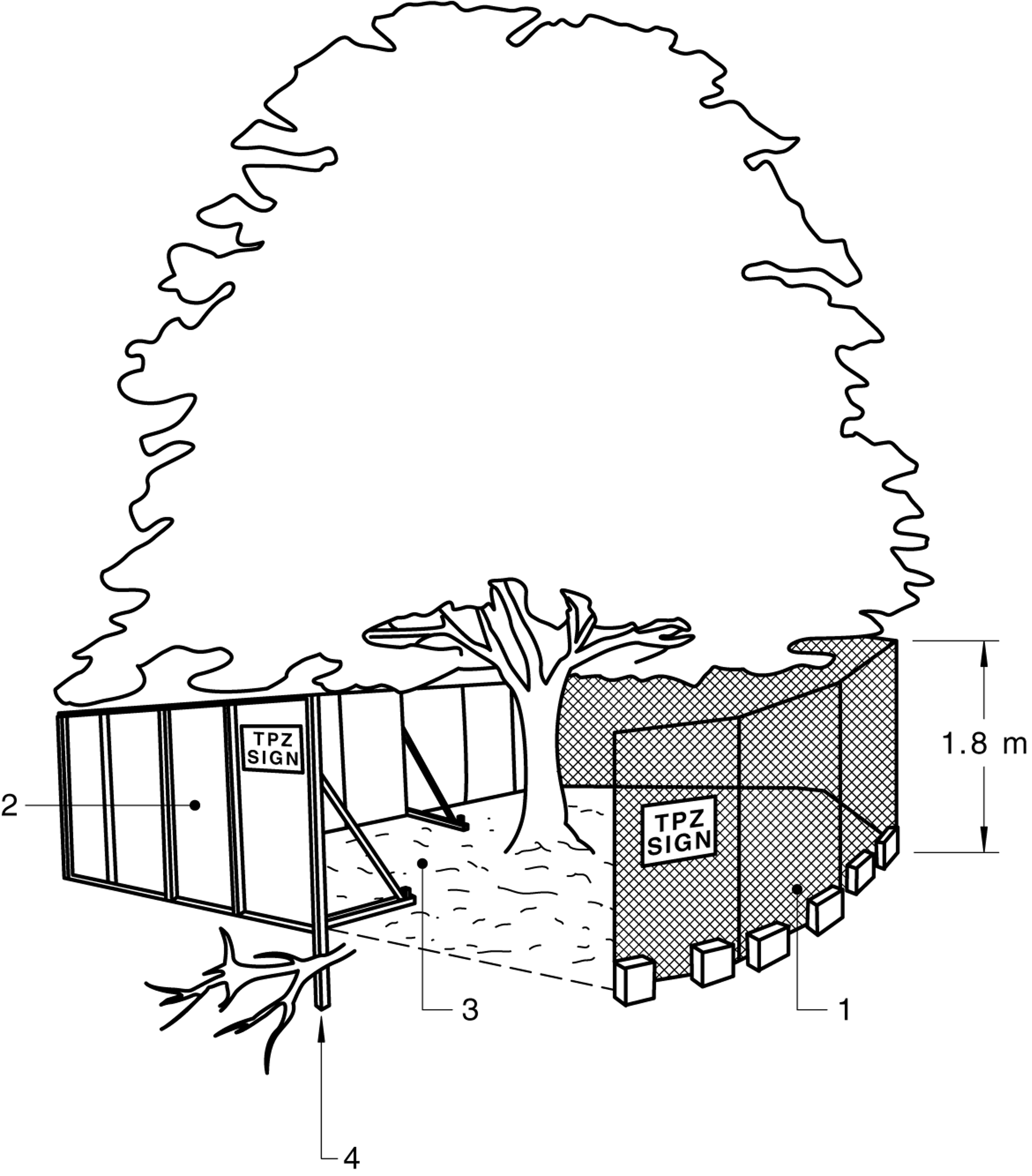
An example of a tree protection fence.
Tree Protection Fencing
In tree health, like in human health, prevention is the best medicine. During construction activities, it is always preferable to block off and avoid the TPZ entirely, usually with tree protection fencing.
Tree protection fencing should be installed prior to any construction. It should encompass as much of the tree’s root area as possible, be robust enough to keep people out, and should have signage affixed clearly explaining its purpose.
However, as in the case of the new Cannons Creek Library project, total avoidance of the root areas of mature trees is not always possible.
Compaction
During construction, heavy equipment can compact soils, crushing the tiny spaces between soil particles where air, water, and nutrients move. This limits both the tree’s ability to access and absorb nutrients as well as the area available for roots to expand as the tree grows. Eventually this can cause the tree to decline in health, or impact its stability in high winds.
Compaction can be mitigated by placing cushioning over the soil, usually plywood or construction mats over gravel or mulch, with the latter providing the additional benefits of added nutrients, soil moisture protection, and soil temperature regulation. Whenever work involving heavy equipment is being performed near trees, and where the ground is permeable and not already covered in asphalt or concrete, Tend Trees recommends plywood boards or truck mats over a bed of mulch 100mm thick.
Mechanical Root Damage
Trenching, digging, and root pruning can seriously affect a tree’s stability. Even cutting a few large roots near the trunk can make a tree more likely to tip or sway in wind. Research has shown that the closer roots are cut to the base of a tree, the more its structural stability is reduced (Miesbauer et al., 2025; Smiley, 2008). For younger or smaller-rooted trees, this effect can be dramatic, but even mature trees can be stressed if enough roots are damaged. The damage may not be immediate. Sometimes it takes years or decades for the impacts to show, and stress from mechanical root damage can reduce trees’ ability to cope with other stressors like pathogen infection or drought.
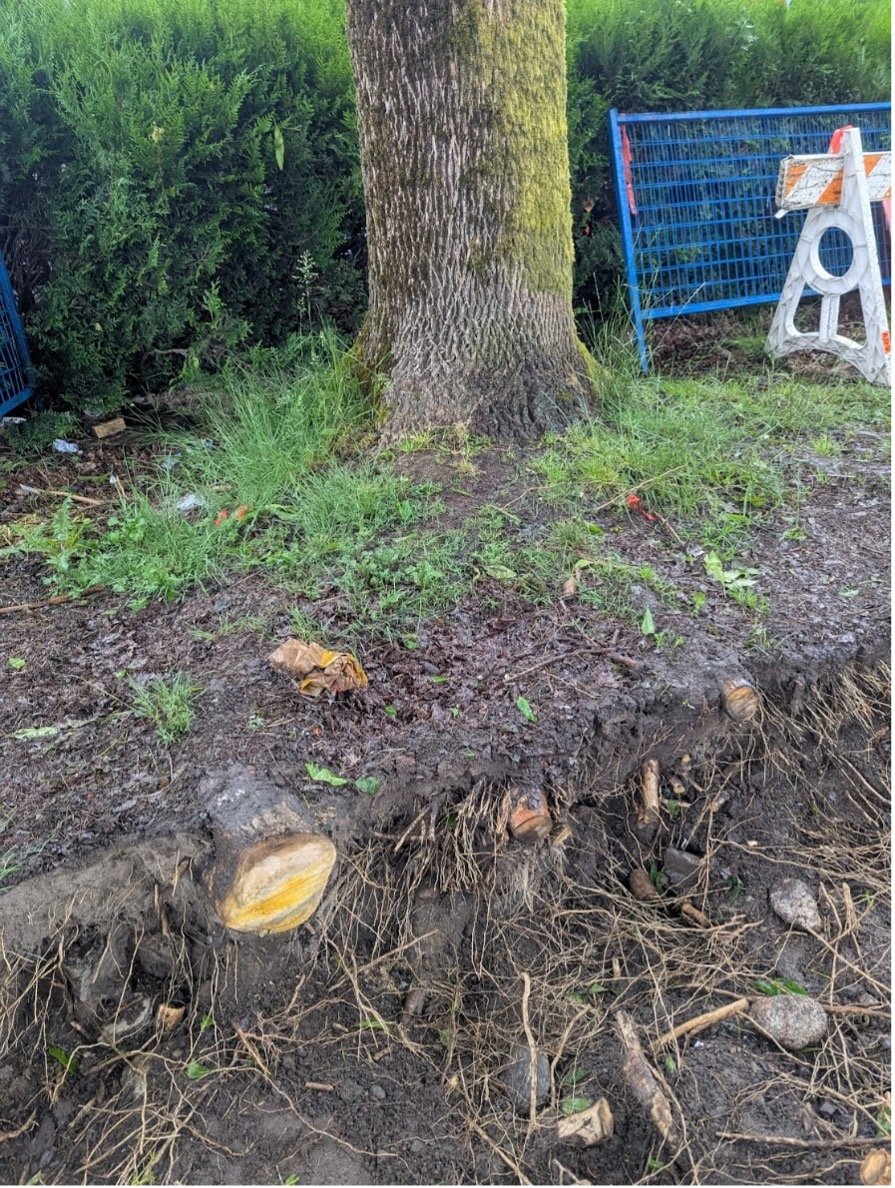
Image Source: Laura Mantin
Root Excavation Techniques Compared
The most obvious source of root damage during construction is from digging and excavation, but not all excavation techniques are equal. Here’s a breakdown of the most common excavation methods and what they mean for tree health:
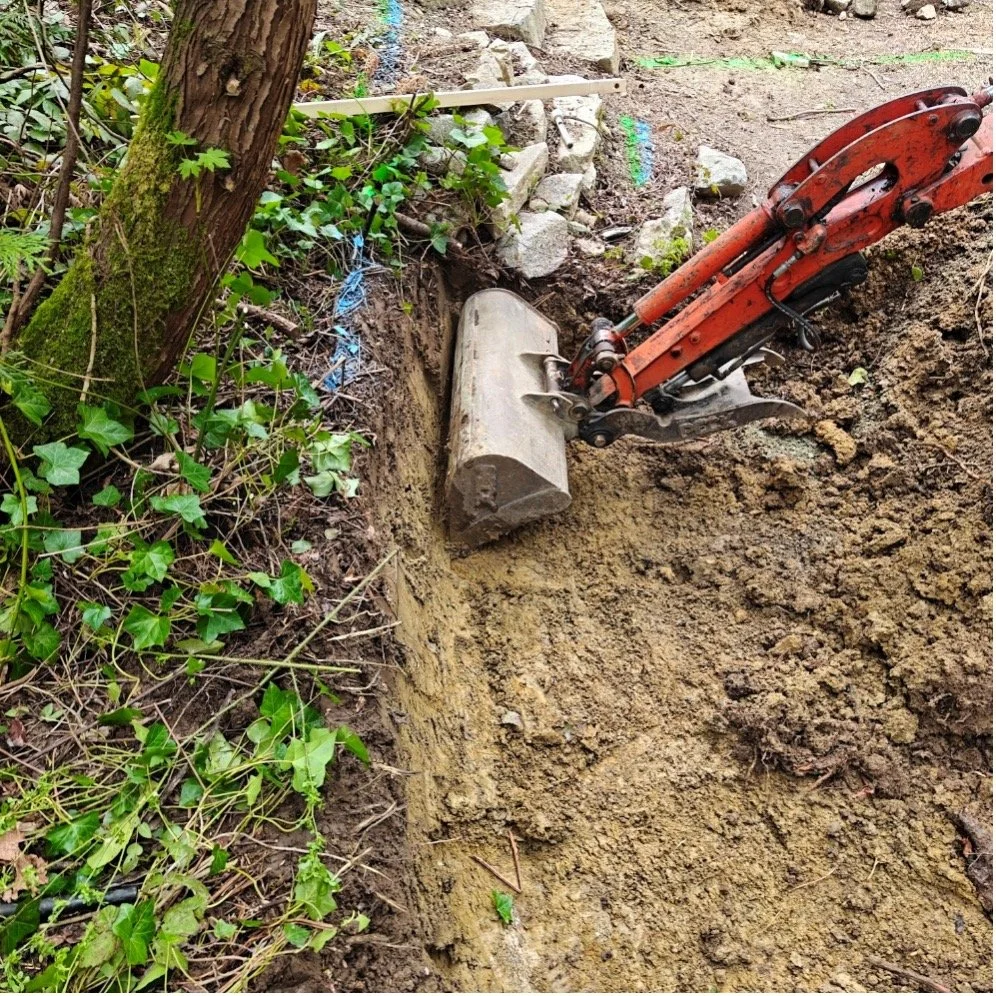
Image Source: Ryan Senechal
Excavator/Hydraulic Digger
Machines in this category range from compact, 1-tonne mini excavators and skid steers through to multi-tonne hydraulic earth movers. They feature a hydraulic digging “arm” fitted with a variety of shovel attachments and usually move around on tracked crawlers, which distribute their load but may limit access in tight or uneven areas.
Although they can be the fastest, and therefore among the cheapest, methods of moving soil, they can cause severe physical damage to tree roots. Even with a very skilled and conscientious operator, digging around intricate root systems can be difficult and limited. Roots (and existing utilities) are often not discovered until damage has already been inflicted, and it can be impossible to dig between or beneath them with large machinery. Doing the job carefully can take enough time that it offsets cost savings. If this method is used, it is best to scrape the soil away in thin layers using a finishing bucket attachment.
Due to their weight, extensive compaction protection is necessary to protect soil structure, and depending on the size of the machine, the digging arm can accidentally damage above-ground tree parts. One advantage is that the original soil can remain on site, reducing disposal and backfill costs while also preserving the same soil the tree has developed in.
Cons
• Can damage roots severely
• Difficult to navigate tight spaces
• Requires skilled operator for careful digging
• Extensive compaction protection needed
• Digging arm may damage above-ground tree parts
Pros
• Fast and efficient
• Cheapest method
• Equipment comes in various sizes
• Soil can remain on site
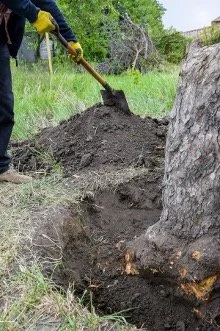
Image source: https://www.dreamstime.com/
Hand Digging
Digging by hand with a spade is a precise way to expose roots, with low initial overhead. The work is gradual and controlled, but it is also slow, tiring, and labour intensive.
Urban soils are often heavily compacted, and significant effort may be required to break through them. When digging with the necessary force, there is a real risk of striking or cutting roots with the spade. Although investment into equipment and skilled labour can be lower cost than other methods, when the speed of work is factored in, it has been found to be one of the most costly methods addressed here.
Excavated soil can remain on site, compaction protection is generally unnecessary, and the method can be used in very tight spaces. However, it is broadly impractical for larger trees with large root areas and is usually best used alongside mechanical methods unless no other options are available.
Cons
Slow and tiring
Expensive
Labour-intensive
Risk of striking roots
Impractical for large-rooted trees
Pros
Very precise
Minimal training required
Can fit into tight spaces
Original soil stays on site
No compaction protection needed
Handheld Pneumatic Excavation Tool (Airspade)
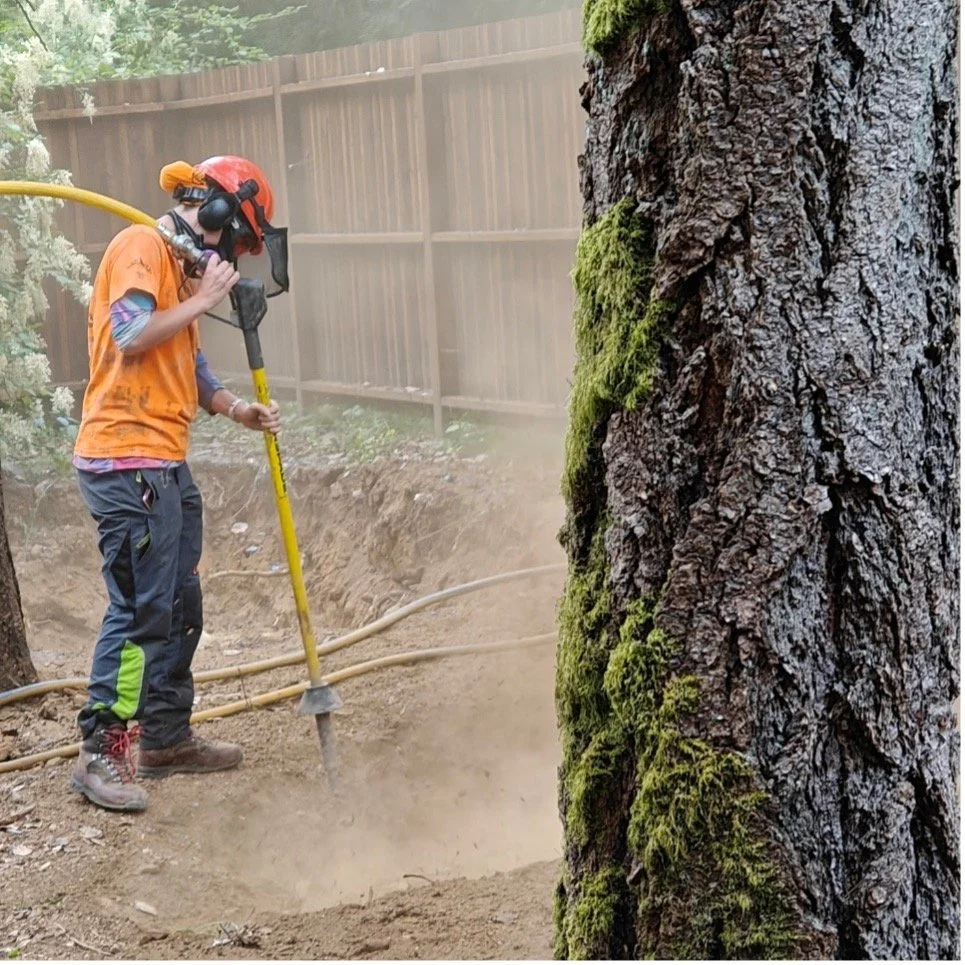
Image Source: Ryan Senechal
One of the most popular and flexible methods of root excavation in recent years has been pneumatic excavation, often known by brand names “Airspade” or “Air-Ex.” This tool consists of a roughly 1.25 m long nozzle-tipped lance with a release trigger, connected to a compressor by high-pressure air hoses.
When directed at the ground, compressed air fractures and displaces the soil without cutting through roots the way a spade or bucket does. The tool is very precise and easy to use, requiring minimal training. It does not require extensive compaction protection, and modular hose segments allow flexible access to tight job sites. Air supply is limited only by the amount of fuel in the compressor.
Impacts on roots are minimal, but it’s important to recognize you can’t disturb soil without some consequences for tree health. In a study comparing excavated poplars with unexcavated ones, researchers Holding & Pepper (2013) found that in the year after airspading, there were no obvious effects on shoot growth, nor on leaf size, colour, or density. At the same time, results may vary by species. Another study by Kosola et al. (2007) found that air excavation caused about 26% more fine-root damage than water-based soil removal (see Hydrovac below) in two of the five species tested. Holding & Pepper also noted that airspading may strip very fine roots of their outer tissues.
There are also a couple practical downsides. Air excavation is loud and messy, and the displaced soil can scatter, creating hazards for the operator and anything fragile nearby. Stones and debris may be thrown around, so protective shields are essential. Face and hearing protection are absolutely required for the operator, with a respirator and goggles strongly recommended. Additionally, because the soil is blown away rather than kept on site, new soil is typically needed for backfilling once the work is complete. On the plus side, this also creates an opportunity to improve soil quality on nutrient-poor sites.
Despite these considerations, pneumatic excavation remains one of the most precise and controlled methods for exposing roots, making it ideal for construction, root pruning, or soil decompaction, particularly in sensitive or tight urban sites. With careful handling and proper safety measures, it lets you get the job done while keeping trees healthy
Cons
Loud and messy
Soil displaced, not kept on site (requires backfill)
Stones/debris can be thrown at surrounds (protective shields needed)
Operator must wear face, hearing, and respiratory protection
May cause some root damage (minimal)
Pros
Very precise
Minimal training required
Flexible access to tight or sensitive sites
Does not require compaction protection
Limited only by compressor fuel
Minimal root impact compared to digging
Water Suction Excavator (Hydrovac)
Hydrovac excavation uses high-pressure water to break up soil around roots, followed immediately by vacuum suction to remove the resulting slurry. A large water tank is affixed to a truck, and the operator uses a large articulating hose to simultaneously control the water expulsion and suction. The soil particles mix with water, and the combination is then sucked into the truck tank for disposal.
As the fastest method discussed here, this method works very quickly, able to move large volumes of soil up to three meters deep. In select tree species, this method has been recorded to cause less fine-root damage than pneumatic air excavation (Airspade, see above). However, research by Hamilton (2000) found that a 200 psi water jet removed most root bark from larger exposed tree roots that were fixed in place and unable to move under impact.
This method requires a trained operator with appropriate truck licencing, which can translate to higher hourly labour costs, but this may be negated by speed and efficiency. Hydrovac trucks are usually large, may not be manoeuvrable to all job sites, and require compaction protections.
Compared to airspading, Hydrovac is considerably tidier. It produces little airborne dust or debris and requires minimal cleanup. The trade-off is water use and waste generation. Rizzo & Gross (2000) reported that for each unit of soil removed, approximately ten units of slurry volume are produced. Depending on the amount of soil to be removed, this can translate to expensive disposal costs, and may require the truck to be filled and emptied several times over the course of a single job, which may cause jobsite delays.
Contaminated urban soils, slurry transport and disposal may require permitting or specialized facilities. Even in clean soils, removing material from site necessitates importing new soil for backfill. It has been suggested that introducing water directly to exposed roots could increase pathogen risk, although current research has not confirmed this.
Cons
Higher equipment and operator costs than some other methods
Large truck requires access and compaction protection
Limited manoeuvrability in tight urban sites
High water use
Significant slurry waste volume (≈10× soil removed)
Disposal may require permits in contaminated soils
Root bark damage possible at high pressures
Requires imported soil for backfill
Pros
Very fast excavation
Capable of deep excavation (up to ~3 m)
Generally less dust and debris than airspading
Can reduce fine-root damage in some species
Efficient for large soil volumes
AirVac
AirVac is the newest of the common root excavation methods and combines elements of both hydrovac and pneumatic excavation. It loosens soil with a jet of compressed air (like airspading) and immediately captures the material using vacuum suction (like hydrovac systems). Machines can be truck-mounted for large-scale works or supplied as smaller, more manoeuvrable units suited to constrained sites.
Compared to airspading, AirVac is far more tidy and controlled. Airspading disperses soil, can fling stones, and creates dust and debris that require shielding, cleanup, and can disrupt surrounding areas. AirVac captures the material as it is loosened, reducing mess, improving site safety, and limiting disruption. It is also faster than airspading alone, which can reduce labour costs.
Compared to hydraulic excavation, AirVac reduces water consumption and eliminates the generation of mud slurry, removing the need for repeated tank refilling and disposal. Because slurry is not produced, excavated material can be reused as backfill, allowing the original soil to remain on site with or without optional remediation materials. Backfilling with organic material such as mulch can help mitigate future compaction and improve soil structure (Percival et al., 2023; Fite et al., 2011). Research has also suggested that introducing earthworms to amended soils may enhance surrounding, untreated soil structure, expanding the available area for root development (Percival et al., 2025).
Limitations
Requires specialised equipment
Truck-mounted units need site access and space
Debris tank must be emptied when full
Operator training required
Advantages
Tidy and controlled excavation
Captures soil rather than dispersing it
Reduces site cleanup and safety hazards
Original material can be reused as backfill
No slurry generation or water use
Root Excavation Methods at a Glance
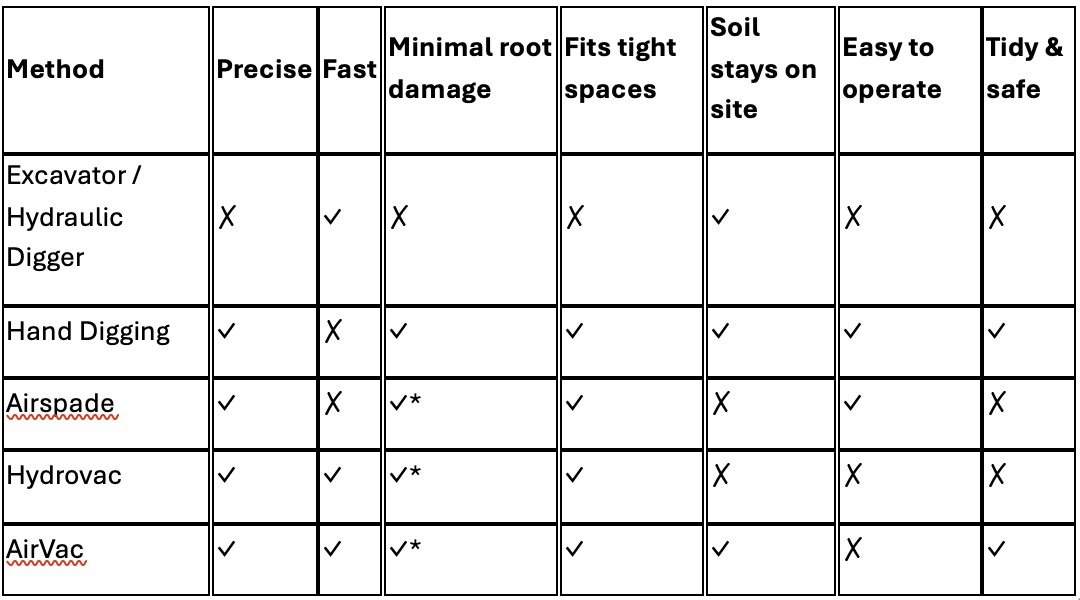
*“Minimal root damage” is context-dependent: species, root size, and operator care all effect outcomes.
Why We Chose AirVac
A Canadian study comparing excavation techniques for utility work found that both HydroVac and AirVac worked out to be approximately 38% cheaper than hand digging and 14% cheaper than hydraulic excavators (Rijal, 2021). Both suction-based techniques reduce personnel requirements, labour hours, and the risk of damage to roots and existing utilities, while lowering workplace hazards such as dust and debris and reducing the area that must be cordoned off for large machinery. Although these benefits apply to both hydrovac and AirVac systems, AirVac further reduces environmental and logistical downsides by eliminating slurry transport and disposal requirements, lowering freshwater consumption, and allowing excavated material to be reused as backfill. This is why we decided that AirVac was the best choice for service installation at the new Cannons Creek Library.
Conclusion
The Porirua District Plan 2025 designates the nearby Cannons Creek Bush as a Significant Natural Area and the broader Cannons Creek area as a Special Amenity Landscape. The expectation in spaces like these is that, wherever possible, natural features are maintained, with removal of vegetation minimised and unnecessary earthworks reduced. That doesn’t mean development can’t happen. It sets the standard for how it should occur.
The new Cannons Creek Library is a good example of that in action. By bringing arboricultural input into the project early and selecting an excavation method suited to working within tree protection zones, we were able to install essential infrastructure without unnecessary disturbance to the seven mature trees on site. The works respected both the construction requirements and the environmental values of the area.
Projects like this demonstrate that planning objectives and practical construction outcomes don’t need to be at odds. When environmental constraints are understood from the outset and methods are chosen deliberately, development can proceed in a way that protects the environment, while meeting the needs of growing communities.
If you are planning works in sensitive environments or around established trees, Tend Trees Consultancy can provide practical arboricultural input that can help shape better outcomes for both infrastructure and landscape.
Rizzo, D.M., Gross, R. (2000). Distribution of Armillaria on pear root systems and a comparison of root excavation techniques. In: Stokes, A. (eds) The Supporting Roots of Trees and Woody Plants: Form, Function and Physiology. Developments in Plant and Soil Sciences, vol 87. Springer, Dordrecht. https://doi-org.ezproxy.waikato.ac.nz/10.1007/978-94-017-3469-1_30
Kosola, K. R., Workmaster, B. A. A., Busse, J. S., & Gilman, J. H. (2007). Sampling Damage to Tree Fine Roots: Comparing Air Excavation and Hydropneumatic Elutriation. HortScience, 42(3), 728–731. https://doi.org/10.21273/HORTSCI.42.3.728
Hamilton, W. D. (1988). Significance of Root Severance on Performance of Established Trees. Arboriculture & Urban Forestry, 14(12), 288–292. https://doi.org/10.48044/jauf.1988.070
Miesbauer, J. W., Koeser, A. K., & Kane, B. (2025). Impact of Trenching on Root Loss and Tree Stability. Arboriculture & Urban Forestry, 51(1), 94–102. https://doi.org/10.48044/jauf.2024.026
Smiley ET. 2008. Root pruning and stability of young willow oak. Arboriculture & Urban Forestry. 34(2):123-128. https://doi .org/10.48044/jauf.2008.016